Our history.
From Okinawa and Shito-ryu to Shukokai in the UK.
Karate-do
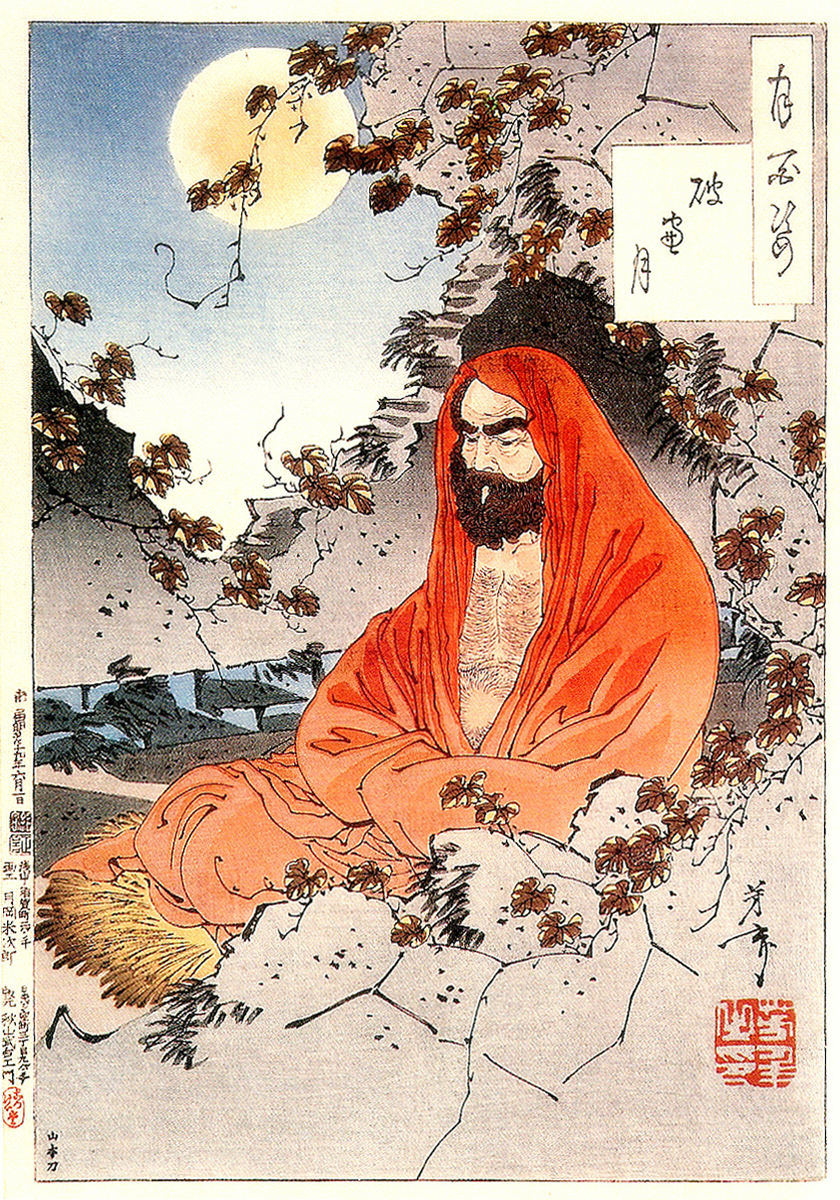
Legend has it, the evolution of Karate began over a thousand years ago, possibly as early as the fifth century B.C., when a Buddhist monk by the name of Bodhidharma arrived at the Shaolin temple in China, from India, where he taught Zen Buddhism. He also introduced a set of exercises designed to strengthen the mind and body, exercises that allegedly marked the beginning of the Shaolin style of temple boxing. Bodhidharma's teachings later became the basis for the majority of Chinese martial arts. Little was known about the early development of Karate until it appeared in Okinawa.
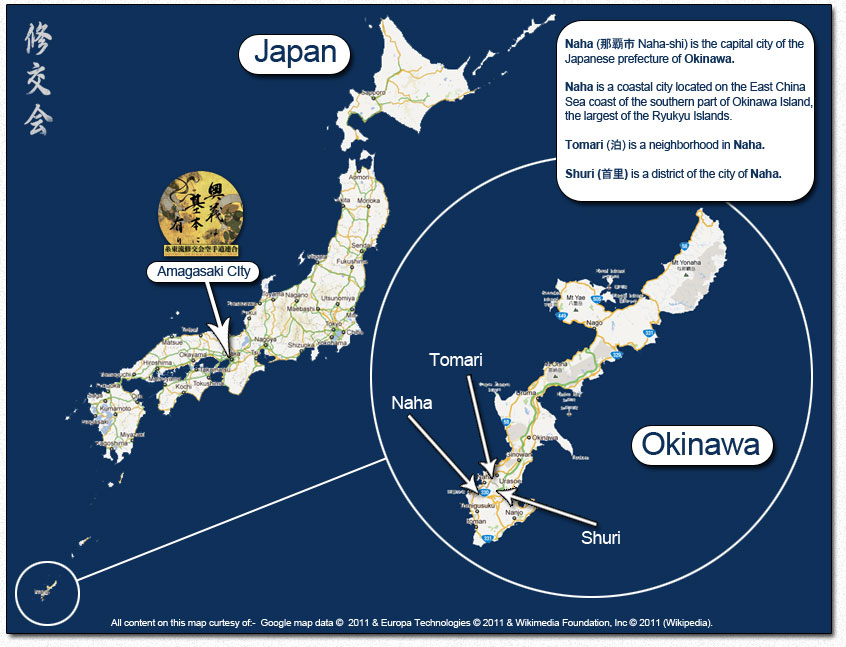
Okinawa is a small island of the group that comprises modern day Japan. It is the main island in the chain of Ryuku Islands,
which spans from Japan to Taiwan. Being at the cross road of major trading routes, its significance as a 'resting spot' was first
discovered by the Japanese. It later developed as a trade centre for south East Asia, trading with Japan and China amongst others.
In it's early stages, the martial art known as "KARATE" was an indigenous form of closed fist fighting which was developed in Okinawa
called "Te", or "hand". Further refinement came with the influence of other martial arts brought by nobles and trade merchants to the island.
Te continued to develop over the years, primarily in three Okinawan cities: Shuri, Naha and Tomari. Each of these towns was a centre to
a different section of society: kings and nobles, merchants and business people, and farmers and anglers, respectively. For this reason,
different forms developed within each city and subsequently became known as: Shuri-te, Naha-te and Tomari-te, collectively they were
called "To-de" "Chinese Hand". Gradually, two main groups were formed: Shorin-Ryu, which developed around Shuri and Tomari and
Shorei-Ryu from the Naha area.
The Chinese character used to write To-de could also be pronounced 'Kara' thus Te with Kara-te Jutsu or 'Chinese hand art’ by the
Okinwan masters. This was later changed to Karate-do by the Japanese who adopted an alternative meaning for the Chinese character.
From this point on the term, Karate came to mean 'Empty Hand'. The 'Do' in Karate-Do means 'way' or 'path',
and is indicative of the discipline and philosophy of Karate with its moral and spiritual connotations.
The first public demonstration of Karate in Japan was in 1917 by Gichin Funakoshi,
who was also instrumental in changing the name to KARATE-DO.
Today there are four main styles of Karate-do in Japan:
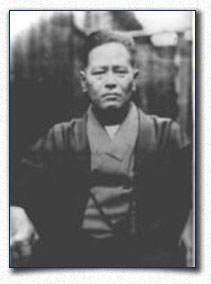
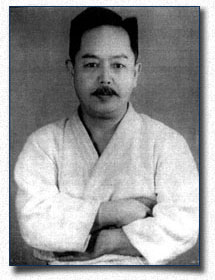
Shito-ryu founded by Kenwa Mabuni (1889-1952)
Goju-ryu founded by Chojun Miyagi (1888-1953)
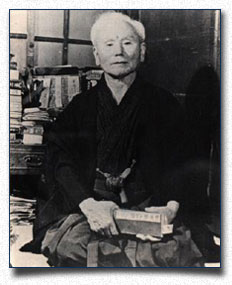
Shoto-kan founded by Gichin Funakoshi (1868-1957)
Wado-ryu founded by Hironori Otsuka (1892-1982)
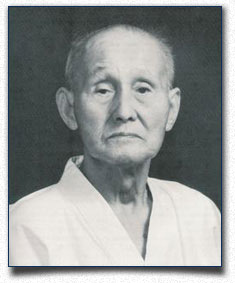
Shito-ryu
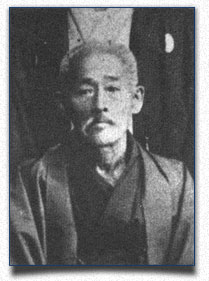
Shito-ryu Karate, was founded by Kenwa Mabuni Sensei (1889-1952)
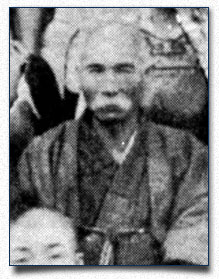
When he was 13 years old, Kenwa Mabuni Sensei began his training in Shorin-ryu with Anko Itosu Sensei, a noted Karate master,
in the Shuri area of Okinawa. Itosu Sensei was not only highly skilled in Budo but also a great innovator in teaching the martial arts.
Around 1905, Itosu Sensei introduced Karate into the Okinawan public school system. Among other accomplishments,
Itosu Sensei created the Pinan Kata, which are still practised today as introductory or intermediate forms in many schools.
Itosu Sensei had an important effect on Karate in the 20th Century.
Evidence of this can be found in the number of Karate styles that trace their lineage back to him.
In about 1909, through an introduction by his friend Chojun Miyagi Sensei (Founder of Goju-ryu) Mabuni Sensei
started to train with Kanryo Higaonna, in Shorei-ryu. Higaonna Sensei was a great expert from the Naha region of Okinawa.
In 1915, both Itosu Sensei and Higaonna Sensei passed away within a short time of each other. Mabuni Sensei continued his training.
Ultimately, he and Miagi Sensei joined with other students of Karate to start a research group aimed at practising and spreading Karate.
In 1929, Mabuni Sensei moved his entire family to Osaka. There he established a small dojo and began teaching his unique art,
which was an eclectic mix of Shorin-ryu (Itosu) and Shorei-ryu (Higaonna), with some Kata from the White Crane
that were taught to him by the legendary Go Kenki, a Chinese tea merchant who would visit Okinawa on business.
Mabuni Sensei ultimately decided to name his art 'SHI TO' which was formed by taking the first two characters (kanji)
from the names of his two primary teachers, Itosu and Higaonna. Thus, the name Shito Ryu has no literal meaning
but rather honours the two main teachers in Mabuni Sensei's life.
Mabuni Sensei worked tirelessly to teach Karate throughout Japan, and the impact that he had on the development of
Japanese
Karate was tremendous. Many groups trace an element of their lineage back to him. Kenwa Mabuni died on 23rd May 1952.
Shukokai
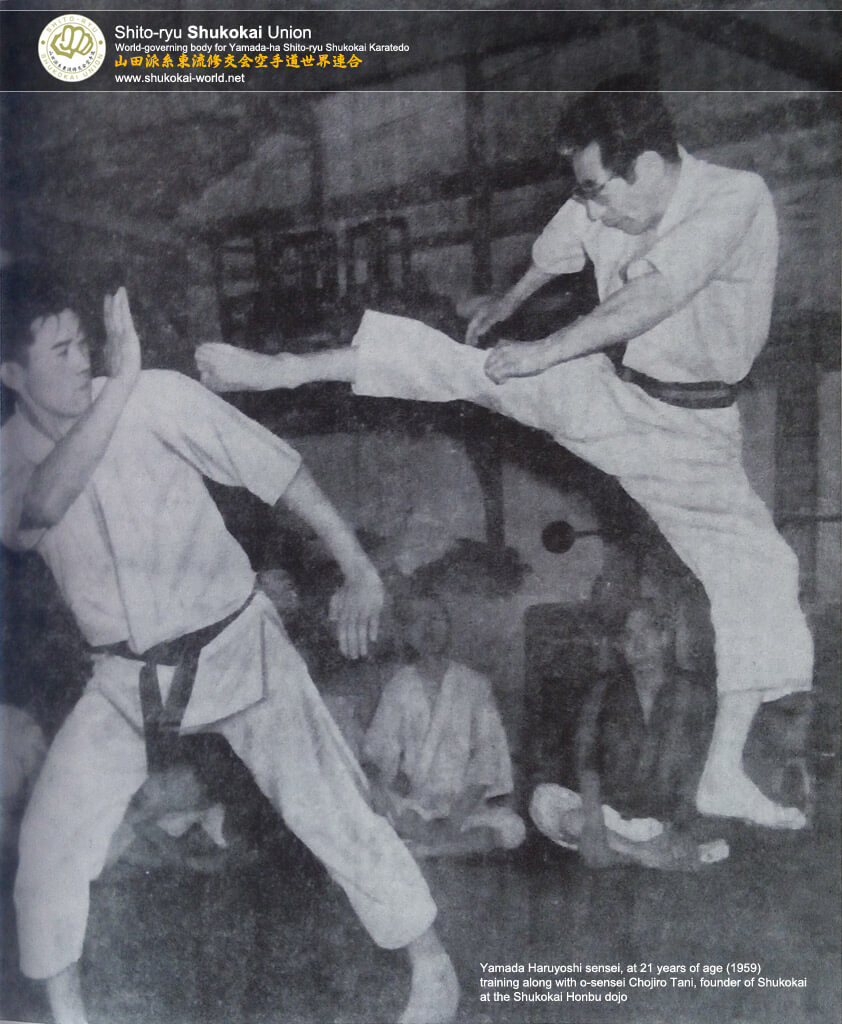
His group (Shukokai) soon grew and one year later, he built his own dojo attached to his house. In 1946, Tani Sensei was presented witth
the scroll of succession from Master Mabuni and was given permission to start up his own sect, Tani-ha Shito-ryu.
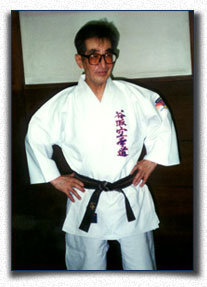
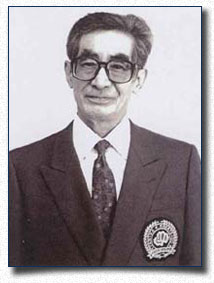
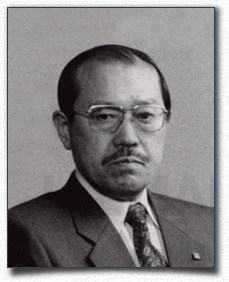
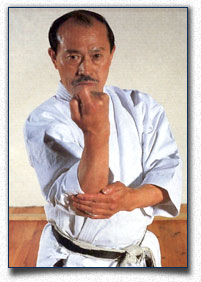
Master Yamada passed away on Sunday 7th January 2018.
The Union
The United Kingdom
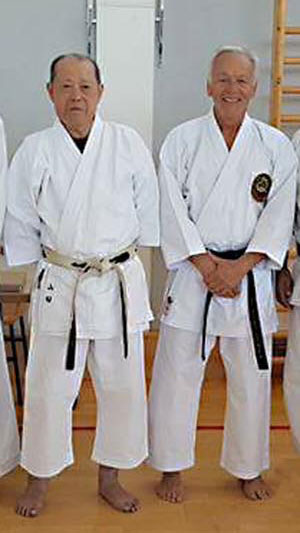
SOKE YAMADA HARUYOSHI - HONOURARY PRESIDENT
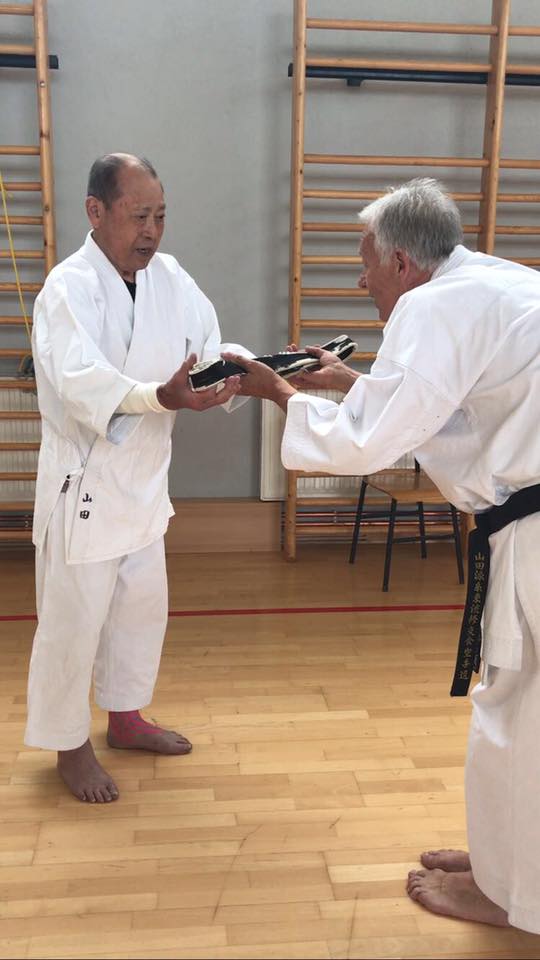
Master Yamada's Tokaido Gi and Obi
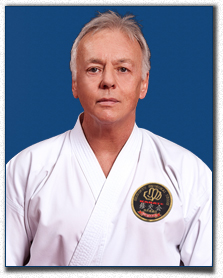
Presented to Denis Casey Sensei
The occasion was the world union International seminar held in Croatia.
The Shukokai
Click this link
Titles Awards 2020
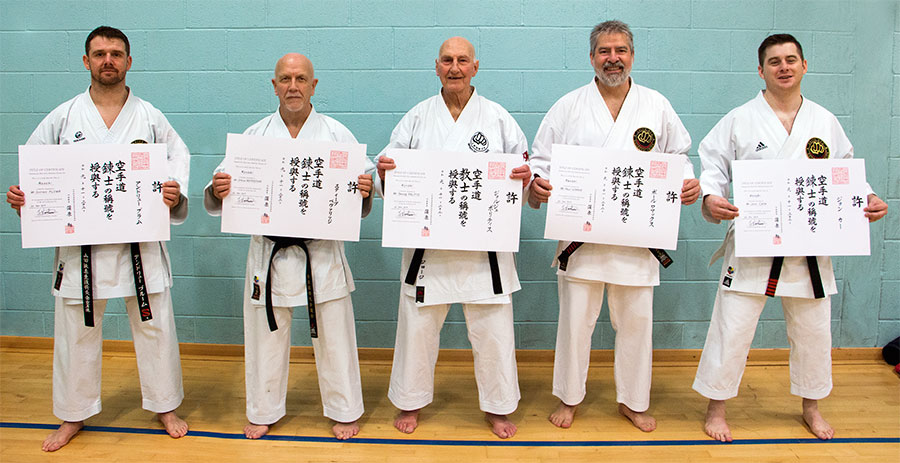
I have the honour in posting this photo of the YSSKWU UK Titles Awards that were presented to the following high ranking Dan grades in the association by President & Chief Instructor Denis Casey Sensei (8th Dan);
Kyoshi Steve Beveridge (6th Dan)
教士 六段 スティーブ・ベヴァリッジ
Kyoshi George Politis (6th Dan)
教士 六段 ジョージ・ポリティス
Renshi Paul Lomax (5th Dan)
錬士 ポール・ロマックス
Renshi John Carr (5th Dan)
錬士 五段 ジョン・カー
Renshi Andy Plumb (5th Dan)
錬士 五段 アンドリュー・プラム
I'm sure this was a great honour and surprise for the Instructors of the association
Many Thanks YSSKWU UK Exec
(and on behalf of Denis Casey Sensei)